The Most Important Person in the Room Usually Isn't Who You Think
Not a CIO. Not a senior executive. But somehow, when she was involved, the entire organization moved better.
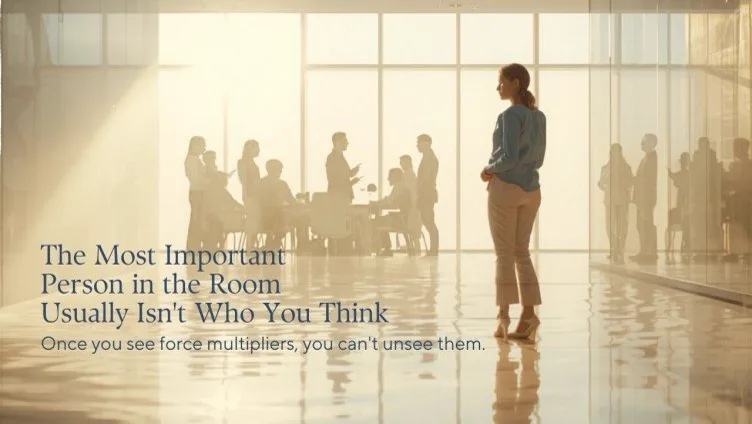
One of the most important people I ever encountered inside a company was an IT project manager. Not a CIO. Not a senior executive. Not the person giving the keynote at the leadership summit. But somehow, when she was involved, the entire organization moved better. Meetings that normally spiraled became clearer. Technical teams trusted her. Business stakeholders trusted her. Executives stopped posturing quite as much. Problems got simpler faster. People left conversations with her thinking more clearly than when they entered.
At the time, I probably would have described her as organized, dependable, a great communicator. All true. But incomplete. What she actually did was harder to measure. She reduced friction, she created trust, she made pressure easier to metabolize. She was a force multiplier. Not because she controlled the organization. Because she stabilized it.
For a long time, I think many companies underestimated these kinds of humans because their value was relational before it was measurable. They were not always the loudest people in the room. They were not always the most politically visible. They were not always the people whose titles made them seem central to the story. But if you watched carefully, something happened around them. The room exhaled a little. People stopped over-explaining. Conversations became less defensive. Problems surfaced earlier, before they turned into full organizational weather systems. The work started moving again.
And once you learn to see these people, you cannot unsee them.
You also start noticing the opposite. The leader everyone prepares emotionally before meeting with. The executive who generates complexity faster than movement. The person who somehow turns every conversation into an endurance sport.
For a very long time, the water was deep enough for organizations to confuse the appearance of leadership with actual movement. Deep enough to reward polish over coherence. Deep enough to overlook the people quietly holding systems together. But the water is getting shallower now. AI, acceleration, transparency, compressed teams, and shrinking execution cycles are making it harder to hide what humans actually create around them. And that is going to change how we evaluate leadership.
The better question
The old question was: "Who looks impressive?" The better question now is: "What happens to other humans around this person?" Do people become clearer? Do they tell the truth sooner? Does the system move, or does everything become heavier? These may become the defining leadership questions of the AI era.
Because artificial intelligence will increasingly amplify informational capability. But the humans who create clarity, trust, steadiness, discernment, and emotional coherence under pressure? Those humans are becoming more valuable, not less. The real story of AI is not that it eliminates human value. It reveals it.
The Signal
Observations like this, delivered directly.
No spam. No filler. Just the patterns that matter.